


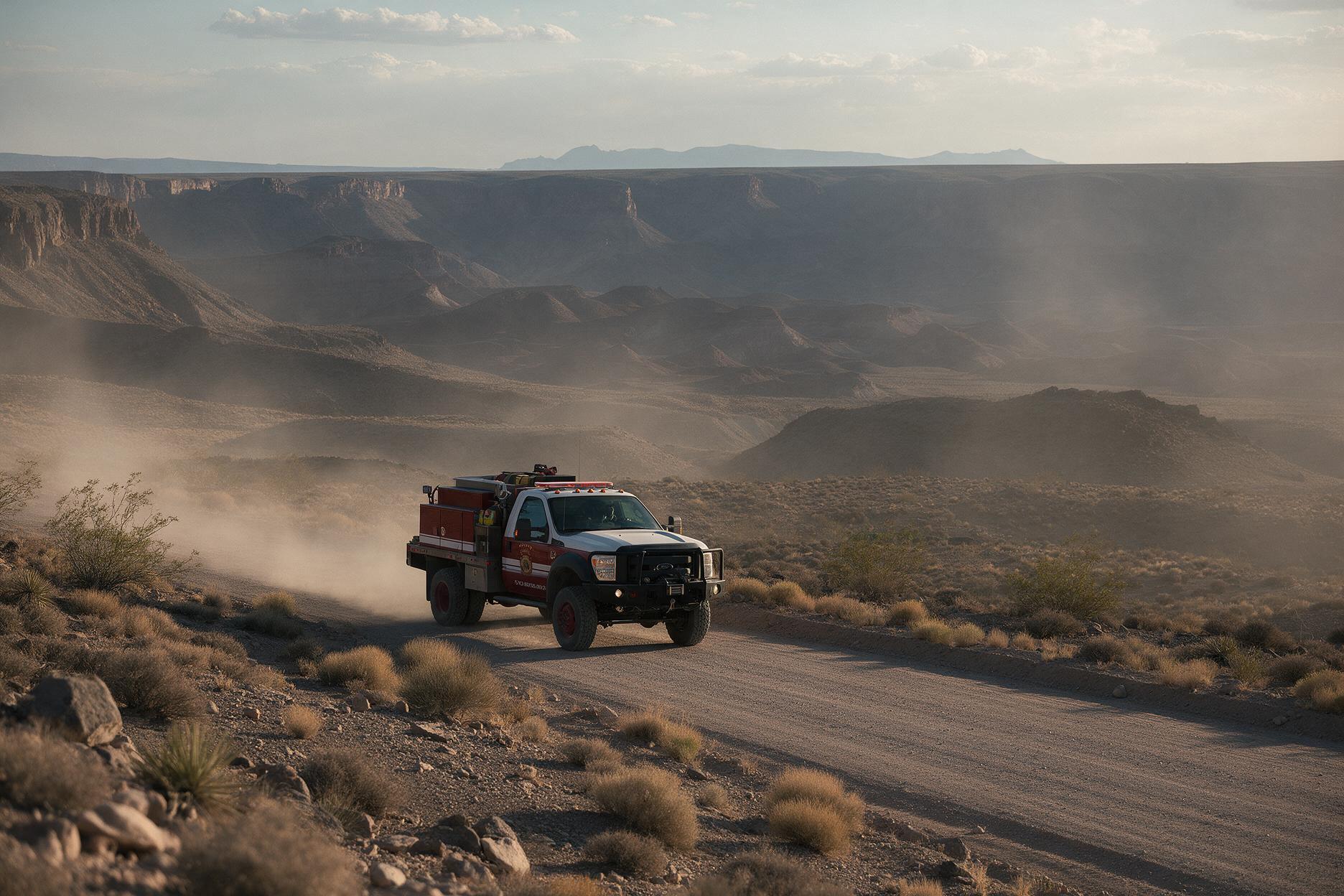


Most emergency response doctrine assumes a baseline that rural communities simply don't have: reliable communications, paved access, mutual aid fifteen minutes out, and a hospital twenty minutes further. Strip those away and you're not doing the same job slower — you're doing a different job.
Operating in austere and remote environments is not about enduring hardship. It's about designing around it deliberately, before the incident, so that limited infrastructure doesn't become the factor that decides outcomes.
What Actually Fails First
- Communications. Cellular coverage gaps, dead zones in canyon terrain, and radio systems that don't interoperate with arriving mutual aid.
- Access. Single-road communities, seasonal crossings, and terrain that turns a twenty-minute transport into a two-hour evacuation.
- Endurance. Distance from resupply means every consumable — fuel, food, water, batteries — becomes a planning variable, not a trip to the store.
- Visibility. Agencies can't manage what they can't see: assets, personnel, and incident status scattered across people and paper.
Designing Around the Gap
Effective austere operations start with honest assessment. Where are the single points of failure — the one bridge, the one radio repeater, the one medic? What is the actual time-to-capability for mutual aid, measured rather than assumed? What can be pre-positioned, pre-planned, or pre-trained before any of it is needed?
Technology plays a role, but only the right kind. Tools built for well-resourced urban agencies fail in low-bandwidth, power-limited environments. What works in austere settings is field-ready, simple to sustain, and usable by volunteers after one training cycle.
What This Looks Like in Practice
A county with three volunteer fire departments and no hospital within forty-five minutes maps its real — not aspirational — response capability: coverage, transport times, resource inventories. The gaps become a plan: pre-staged equipment, trained community responders, and sustainment logistics sized to a multi-day isolation event.
Conclusion
Constraint is not the same as incapability. Communities that plan around their infrastructure instead of pretending it away build real, measurable readiness.
Operating where the infrastructure isn't? Contact us to talk about what your community actually has to work with.
